“Strength with unity”: Ireland’s EU Presidency begins with broad support, but calls for stronger social action
21 July 2026 /
Tatiana Pires 4 min
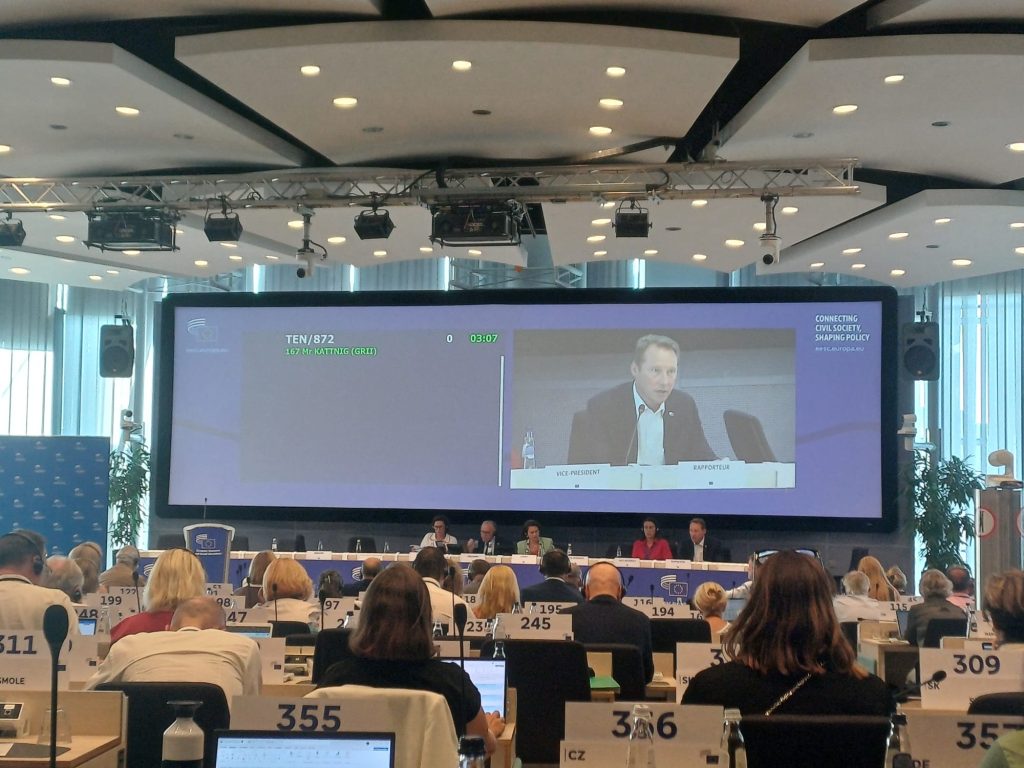
“Strength with unity” is the motto guiding Ireland’s six-month Presidency of the Council of the European Union. Presenting its programme at the July 607th plenary session of the European Economic and Social Committee (EESC), Ireland’s Minister of State for European Affairs and Defence, Thomas Byrne, outlined an ambitious agenda centred on competitiveness, values and security. While these 3 priorities received broad support, the debate also raised an important question: can economic competitiveness go hand in hand with stronger social action?
Three priorities for a changing Europe
Speaking before the EESC, Mr. Byrne described the Irish Presidency as an opportunity to deliver tangible benefits for both Irish and European citizens. Built around the slogan “Ní neart go cur le chéile”, Irish for “Strength with unity”, the Presidency aims to strengthen Europe’s economy while protecting its democratic values and responding to an increasingly uncertain geopolitical environment.
Competitiveness will be one of Ireland’s central priorities. Mr. Byrne highlighted the need to deepen the Single Market, reduce unnecessary administrative burdens for businesses and help small and medium-sized enterprises (SMEs) grow. Closing Europe’s innovation gap and advancing the European Commission’s proposals to simplify EU rules will also feature prominently during the Presidency.
Alongside economic priorities, Ireland intends to promote democratic resilience through initiatives such as the proposed Democracy Shield, support efforts to make the online environment safer for children, continue backing Ukraine against Russia’s ongoing aggression and advance EU enlargement for candidate countries that meet the necessary conditions and implement the required reforms . “The Irish Presidency will continue its work to find consensus between Member States,” Mr. Byrne said, adding that these priorities would be underpinned by “meaningful engagement with citizens and civil society.“
Giving civil society an earlier voice
That commitment to dialogue is reflected in Ireland’s close cooperation with the EESC. As announced at the plenary session, the Irish Presidency has requested 8 exploratory opinions from the Committee, a mechanism allowing organised civil society to provide recommendations before the European Commission drafts new legislation. Unlike traditional consultations that often take place later in the legislative process, exploratory opinions enable employers, workers and civil society organisations to help shape policy from the outset.
The requested opinions cover areas including competitiveness and equality, support for SMEs, digital fairness, affordable housing, intergenerational poverty and agriculture, highlighting Ireland’s intention to combine economic priorities with broader societal concerns.
The partnership will also include a high-level conference on affordable housing in Dublin later this year and several cultural events celebrating Irish heritage throughout the Presidency.
A common diagnosis with different priorities
Although the Irish programme was broadly welcomed, the discussion that followed illustrated the different expectations held by Europe’s social partners.
For Sandra Parthie, President of the EESC’s Employers’ Group, the priority is clear: Europe must move beyond identifying problems and start implementing solutions. “Ireland knows what it takes to turn a lingering economy into a competitive one,” she argued, describing competitiveness as essential for creating quality jobs, financing the green and digital transitions and preserving Europe’s social model. She called for further simplification of EU rules, a stronger Single Market and an open trade policy capable of supporting European businesses.
Others argued that economic competitiveness alone cannot answer citizens’ concerns. Lucie Studničná, President of the EESC’s Workers’ Group, urged the Presidency to place greater emphasis on social policy. Pointing to rising housing costs, persistent poverty, the cost-of-living crisis and limited access to high-quality jobs, she warned that many Europeans feel increasingly disconnected from European institutions: “Your motto is ‘Strength with unity’. True unity comes from solidarity, but we do not see any significant reference to social policy in your priorities,” she said, calling for “a Europe that works for its people.”
The importance of involving organised civil society throughout the policy-making process was also highlighted by Cillian Lohan, President of the EESC’s Civil Society Organisations’ Group. He stressed that Europe’s democratic values and long-term peace depend on ensuring civil society remains actively involved in shaping EU policies, while sustainable development continues to guide the Union’s future.
The challenge ahead
The exchange revealed a broad consensus on Europe’s challenges. Competitiveness, security, democratic resilience and economic prosperity all remain pressing priorities. The debate was not about whether these issues matter, but about how they should be addressed and which should take precedence.
Ireland therefore begins its Presidency with an important advantage: broad support for its overall direction. Yet the discussions at the EESC showed that the Presidency’s success will ultimately depend on its ability to balance economic ambition with social cohesion while maintaining meaningful dialogue with Europe’s organised civil society.
Over the next six months, the Presidency will not simply be judged on the priorities it has announced, but on whether its promise of “Strength with unity” can translate into concrete progress for European citizens.