PRESS BREAKFAST AND PLENARY SESSION AT THE EESC: ENERGY, HOUSING AND DRONE SECURITY
20 July 2026 /
Antonio Cardone 9 min
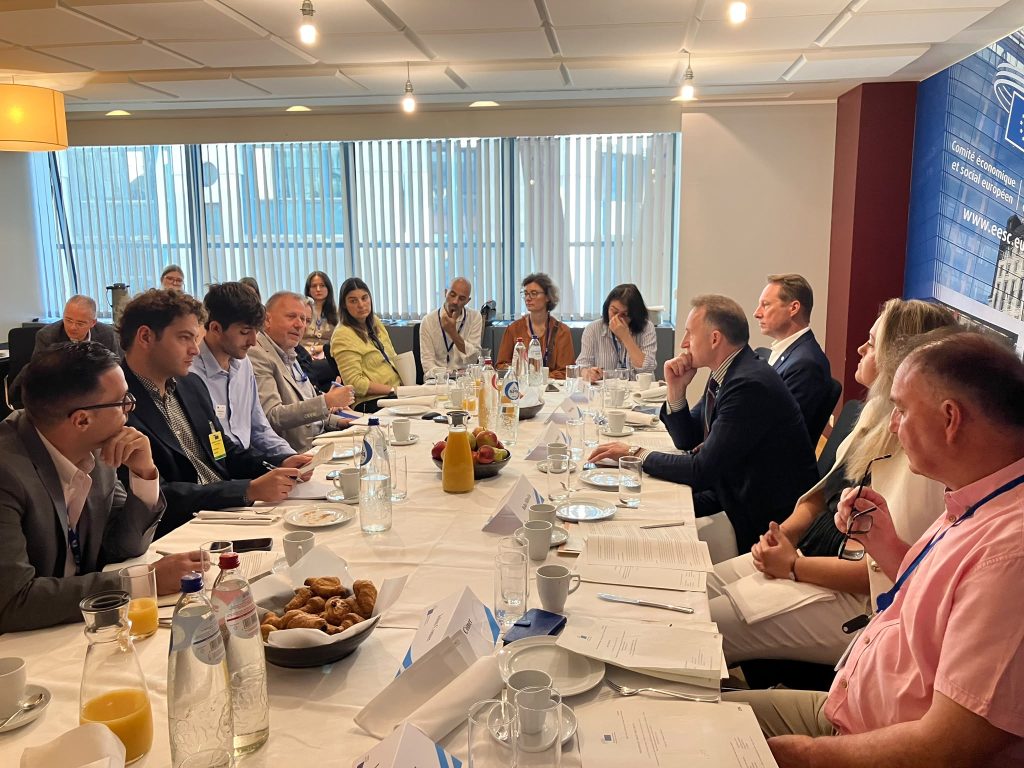
Ahead of the European Economic and Social Committee’s (EESC) July plenary session, Eyes on Europe was invited to a press breakfast where rapporteurs introduced three opinions that would later be debated during the plenary. Covering strategic energy storage, housing construction and drone security, the discussions pointed to a broader question: can the European Union strengthen its strategic capacity without weakening affordability, social rights and democratic accountability?
The EESC occupies a distinctive position within the institutional system of the European Union. It does not adopt legislation; it is a consultative body representing employers, workers and other organisations of civil society. Through its opinions, the EESC seeks to introduce economic, social and civic perspectives into European policymaking before and during the legislative process. It is the institutional bridge between citizens and the legislative bodies of the EU.
Ahead of its 15-16 July plenary session in Brussels, the EESC’s Section for Transport, Energy, Infrastructure and the Information Society organised a press breakfast to present three opinions concerning strategic energy storage, housing construction, and drone and counter-drone security. The dossiers were subsequently discussed in the context of the plenary session. Although they address very different policy areas, the three debates were linked by a common concern: Europe’s ability to respond to external dependencies, social pressures and emerging security threats.
Taken together, the discussions suggested a broader understanding of European resilience. Resilience is often associated primarily with defence, emergency preparedness or the protection of critical infrastructure. Europe’s capacity to withstand crises also depends on whether it can manage its energy transition, provide affordable housing, maintain an effective industrial base, create quality employment and preserve democratic oversight. In each of the three areas discussed at the EESC, the Union has recognised a strategic vulnerability but still lacks some of the common instruments needed to address it.
Energy storage: Europe’s missing infrastructure
Energy storage is one of the clearest examples. Europe’s recent energy crises have demonstrated the risks produced by external dependence. Russia’s invasion of Ukraine transformed the political debate surrounding imports of Russian fossil fuels, while instability around strategic routes such as the Strait of Hormuz continues to expose the vulnerability of global energy supplies.
The expansion of renewable energy can reduce some of these dependencies, but it also creates new technical requirements. Unlike conventional energy sources, wind and solar generation fluctuate according to weather conditions. Electricity must therefore be stored when production is high and made available when demand exceeds immediate supply. Storage is an essential part of the distribution and redistribution of energy across an increasingly complex European grid.
The EESC argues that the EU still lacks a sufficiently comprehensive strategy for energy storage. According to the Committee, storage infrastructure is necessary to make the transition technically feasible, economically affordable, socially fair and territorially balanced. The central issue is not only how much storage capacity Europe needs, but which technologies should be developed, where infrastructure should be located and how investments should be financed.
Public investment and the limits of the market
The most politically significant part of the EESC’s position is its conclusion that market-based investment alone will not provide the necessary scale, timing and technological mix. Large storage projects require considerable initial investment and operate within electricity markets characterised by uncertainty. Private companies may therefore lack sufficient incentives to build the required infrastructure at the right speed or in locations that are strategically important but less immediately profitable.
For this reason, the Committee calls for public strategic planning, complementary public funding, support from the European Investment Bank, regulated markets and long-term investment models. It also includes public ownership, regulated asset models and public-community partnerships among the possible instruments.
A European strategy would not necessarily require a single technological solution. Storage can include batteries, pumped hydropower, thermal systems, hydrogen and other technologies suited to different territorial and economic conditions. As was underlined during the press exchange, a “one-size-fits-all” approach would be inadequate. The European level could instead provide common objectives, investment guidelines and coordination while allowing national and regional authorities to select solutions appropriate to their energy systems.
The opinion also places employment and skills at the centre of the transition. Storage infrastructure will require engineers, technicians, construction workers and specialised industrial capacity. Energy sovereignty cannot be achieved simply by importing and installing new technologies. It also depends on Europe’s capacity to finance, manufacture, operate and maintain them. Vocational education, upskilling, social dialogue and high labour standards are therefore not secondary consequences of the energy transition but part of its success.
Housing: renovation before new construction
The housing dossier raises a similar question about the relationship between industrial capacity and social outcomes. The European Strategy for Housing Construction aims to increase the supply of renovated, repurposed and newly built homes by strengthening the competitiveness of the construction sector, accelerating innovation and digitalisation, improving access to materials and addressing labour and skills shortages.
The discussions at the press breakfast highlighted how bureaucratic obstacles contribute to Europe’s low renovation rates. At the same time, new construction represents only one part of the possible response. Vacant homes, abandoned buildings and underused residential properties can be converted, while much of the existing housing stock requires extensive energy renovation.
This approach connects housing policy with the circular economy. Reusing existing structures and construction materials can reduce waste, land consumption and environmental pressure. Renovation can also lower household energy expenditure, linking the housing crisis to the wider question of energy affordability. Such projects, however, require access to financing, effective spatial planning, technical skills and public authorities capable of coordinating interventions over the long term.
Affordability remains the real test
The EESC calls for greater funding, stronger protection for vulnerable groups and more attention to conversions, collective housing and climate-neutral, resource-efficient construction. It also proposes recognising a right to adequate and affordable housing in EU primary law and supports instruments such as mandatory shares of subsidised affordable housing.
The objective is not simply to make the construction industry more productive, but to ensure that its increased capacity produces socially useful results. The underlying question is therefore not only how Europe can build more rapidly. It is whether increased construction capacity will produce homes that people can actually afford and whether renovation policies will improve living conditions without transferring disproportionate costs to tenants and low-income households.
Drones reveal Europe’s industrial gaps
The discussion on drones and counter-drone systems moved the debate more directly into the field of security. The European Commission’s Action Plan on Drone and Counter-Drone Security focuses on preparedness, detection, response and defence readiness. It addresses the civilian internal-security dimension while also promoting closer civil-military cooperation.
Recent conflicts have shown how relatively inexpensive drones can be used for surveillance, attacks and disruption. At the same time, airports, ports, energy facilities and other critical infrastructure remain exposed to unauthorised incursions. Underwater drones add another dimension to the threat, particularly in relation to maritime infrastructure, energy networks and communication systems.
The European challenge is not limited to purchasing counter-drone equipment. It involves industrial capacity, secure supply chains, specialised software, access to critical raw materials and trained personnel. During the press discussion, attention was drawn to Europe’s relative strength in software and its weaker position in some parts of the hardware supply chain. Cooperation and coordination are therefore needed not only for security purposes but also to attract investment and expand production capacity.
The sector also illustrates the increasing importance of dual-use technology. Systems developed for agriculture, logistics, emergency services or infrastructure inspection can be adapted for military and security purposes. The traditional separation between civilian and military applications is becoming increasingly difficult to maintain. Greater integration could support industrial development, but it also raises questions about regulation, accountability, liability and the allocation of public resources.
Who should build Europe’s drone capacity?
A question raised during the press exchange captured the institutional dilemma: should the European Union develop a common and exclusive system for managing its drone industry, or can national governments, industrial champions and intergovernmental cooperation provide the necessary capacity?
A more integrated European system could facilitate common standards, joint procurement, larger-scale investment and economies of scale. However, defence remains an area in which national governments retain different strategic priorities, industrial interests and threat perceptions. A European Defence Union developed only by a limited group of willing states could consequently produce a two-speed Europe, with uneven capabilities and responsibilities.
The EESC supports stronger coordination, the protection and stress-testing of critical infrastructure, and joint procurement. At the same time, it insists that counter-drone measures must remain proportionate and compatible with privacy, data protection, legal certainty and democratic accountability. Public safety and the operational integrity of European air-traffic management must remain central considerations.
Jobs and competitiveness at the plenary
The plenary discussion placed these three dossiers within a wider political debate on competitiveness, labour mobility and the future of the European social model. One of the recurring messages was that European competitiveness cannot be built on low labour costs, precarious employment or weak enforcement of existing rules. Investment in human capital, collective bargaining, occupational safety and professional qualifications is part of Europe’s productive capacity rather than an obstacle to it.
The debate on quality jobs and fair labour mobility also addressed the vulnerability of mobile workers and workers from third countries, including problems connected to subcontracting, recruitment practices, monitoring and enforcement. The use of artificial intelligence in hiring, screening and internal workplace decisions added another dimension to the discussion. Technological innovation may increase efficiency, but it also requires transparency, accountability and mechanisms capable of protecting workers from discriminatory or opaque decisions.
The same reasoning applies to the three dossiers presented during the press breakfast. Energy storage requires skilled employment and long-term investment. Housing construction depends on trained workers, enforceable standards and public planning. Drone security requires technological expertise, industrial coordination and democratic regulation. Social policy is therefore not external to European resilience. It is one of its foundations.
The priorities presented by the Irish Presidency of the Council provided a wider political framework, particularly through their emphasis on the single market, simplification, critical infrastructure, security and democratic resilience. However, simplification must be distinguished from indiscriminate deregulation. Removing unnecessary administrative barriers may facilitate renovation, construction and strategic investment. Weakening labour, environmental or accountability standards would instead transfer the costs of competitiveness onto workers, households and local communities.