“The result: complete inconsistency”, Options for EU Trade Policy in Uncertain Times – An interview with MEP Bernd Lange
14 May 2026 /
Fiona Tiekötter 9 min
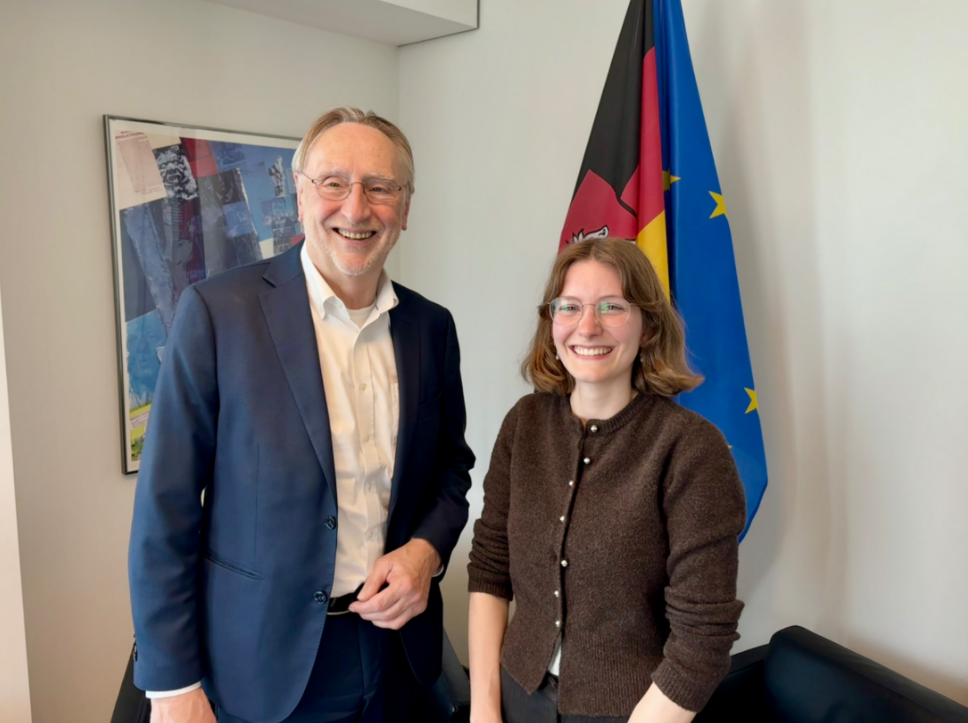
Photo: Bernd Lange (MEP) and Fiona Tiekötter (Eyes on Europe writer)
At a time when the global trade landscape is increasingly defined by uncertainty, we are talking to Bernd Lange (S&D) about the current challenges facing European trade policy. The German Member of the European Parliament (MEP) has served as Chairman of the Committee on International Trade (INTA) since 2014 and has been Chairman of the Conference of Committee Chairs since 2022. Lange, who was a member of the European Parliament continuously from 1994 to 2004 and again since 2009, is considered one of the most influential trade experts in Europe and additionally serves as the Parliament’s standing rapporteur for EU-US trade relations.
In the current global context, especially with a view toward the USA: how can Europe hold its ground? How do you view the current developments with this insight?
The USA has fundamentally changed their strategy, they no longer adhere to rules. That is why what the USA ultimately puts on the table is very spontaneous. Certainly, their first concern relates to the situation in the USA itself in the short run. As a consequence, there are a lot of different political considerations at play, which lead to enormous uncertainty.
The US has unilaterally increased tariffs on several occasions – steel tariffs from 25% to 50%, then tariffs on 407 products from 15% to 50%. Following a Supreme Court ruling that there was no legal basis for these measures, further revisions have since been made. The result: complete inconsistency. And this is of course poisonous for trade relations, for investment decisions regarding trade.
How do you deal with this uncertainty and unpredictability? How are we equipped? What instruments do we have?
There are essentially two strategies. One is trying to reach an agreement. The other is trying to establish countermeasures. Essentially, this is a Va Banque game (a risky card game where one can lose or win everything). At the moment, we are more strongly attempting to achieve stabilization, once again. We are also having a discussion about our obligation to reduce tariffs on US import goods.
Now we have a slight leverage, of course, we can see whether we get corresponding declarations from the USA. On the other hand, there is obviously always the possibility of escalation on our side. That was very much the case, the common desire, during the discussion about Greenland. This is both regarding the tariffs and the aggressive attempt to annex Greenland. That is exactly the tension. This always depends on how one assesses how the USA might react, what security-policy considerations exist, and also how the member states position themselves.
Are you therefore seeing a mix between security policy and trade policy then?
Exactly, this will certainly take some time, but we are increasingly on the path toward the question of military security. And the other weakness is, of course, the digital sector. The USA is also trying to push through its interests and support for Big Tech and question European legislation. So these are two areas where we are really weak compared to the US and this must be compensated. And this will certainly be the task of the next two, three years.
And how can the Industrial Accelerator Act help us in this context? What is your position on the Act?
I believe we really must do our homework. On the one hand, we are hit by these arbitrary tariff measures. And this has already led to a reduction in our exports, especially in central areas, such as mobile machinery construction, around 13-14%. And this is considerable in a situation where the economic situation is developing toward stagnation.
On the other hand, we have a very aggressive Chinese industrial policy that also tries to gain market dominance with unfair means in many areas. This is no secret, it is outlined in the “Made in China 2025” and the 14th and 15th five-year plans. And they are doing this very aggressively.
In such a situation, I think it is important to do our homework, to analyze where the problem lies. We can look at which raw materials we have and what recycling actually looks like, for example we know that 10 of the rare earths are not recycled at all in Europe?
With lithium, the recycling rate is at 30% and in our smartphones, it is at only 10%. There is a lot of work for us here and this is one element of the Industrial Accelerator Act.
That one certainly looks at where lead markets can be organized for innovative products and also how defensive instruments can be organized more strongly. But important, I think, is to really refocus on the competitiveness of industry. And I mean, for a long time, this was a taboo word, no one had industrial policy, one was not allowed to say it. The market must regulate everything. And thus, one essentially entrusted the fate of economic development to managers who decided for purely business-economic reasons. I recently had a fierce argument with a manager from Siemens who said we were naive toward China. I said, that was not naive, that was economic consideration: low wages, low environmental regulations, especially in the refining of lithium, which is a very dirty business. Pretty nice if they do it and we can then use the finished lithium. So, this situation – the market should fix it and business-economic considerations guide everything – does not help in this situation where the other two do not play fairly.
That is why I find it very good that the IAA exists, but a few details still need some work.
Are the sustainability aspects part of those “details”?
Yes, the criteria certainly need to be sharpened again. We need to look at more than environmental conditions, for example workers’ rights must be included as well. One can also look at how long a product is transported. So we should focus on such details.
And as I said, this balance between defensive instruments and stronger promotion of industrial development must be re-examined. Because simply building a wall around Europe does not help. And then, as the saying goes: Behind a wall, nothing actually grows. Therefore, we are talking about fostering the promotion of innovation; this is the same case.
And if you look more closely now at how the principle of “Change through Trade” fits into this, would you say that is “old news”?
No, just because in one or two cases this didn’t work out, I would not generalize it. The Chinese at least adhere to some rules, even if they are condemned sometimes and will grumble a bit, but it is not that they want to break all rules per se. It has been shown in many areas that there is indeed a strengthening of economic development and also opportunities for less developed countries through trade. That this causes a system change – I think some believed this illusion, but I never did.
A social formation arises through the population’s own reflection. And if they live with a dictatorship, then they just live in a dictatorship. This will not change through trade. But through trade, one can induce stability and economic growth, and that is decisive.
In March, you went to the World Trade Organization (WTO) and called for reforms. Would you connect this with truly rules-based trade, that all countries adhere to?
Yes, the system is based on one country, one vote. And this is also an opportunity for less developed countries. For many agreements there is also a different treatment between industrial countries and developing countries. I find that really good.
And with our trade agreements, we also try to achieve that they are asymmetric, that the developing countries benefit more from them. Vietnam is such a prime example, where we had 50% trade volume development in 5 years. About 16% on the European side and 57% on the Vietnamese side.
And I think it is also right that there is a catch-up process here. And because this can stabilize within the WTO, I find that right and good. I would not say that the WTO has failed, but the compromise ability of three, four countries has failed.
And one must see how to deal with that. So I don’t want to say there should be an alternative to the WTO, but perhaps certain elements can be put on the table more strongly together with the willing countries.
Would this be another Coalition of the Willing?
Exactly, we have already conventionally agreed on one thing with this e-commerce legislation with 66 countries. Not as an alternative, but we said we start with it and still want to bring it into the WTO. Get your kicks on Route 66.
And therefore, this is perhaps a possibility, one must look at it more closely. But indeed, it cannot be that China, India, or the USA block important decisions.
Especially in Germany, but also on EU-level, we are often talking about the Supply Chain Act. How would you connect these topics?
We must be very precise here. First of all, there is a differentiation between the European approach and the German approach. I am not convinced by the German approach, because it treats everyone equally. On the EU level, we are having a risk-based approach. There is a difference between the bicycle gear shifter that comes from Malaysia or the maple syrup, which is from Canada.
The risk that forced labor occurs during the production of the gear shifter from Malaysia is greater than during the production of maple syrup in Canada. Additionally, the responsibility lies with companies, they have to consider the fundamental and internationally valid agreements, such as the EU-Canada norms, UN environmental standards, or the Paris Climate Agreement.
This means we also have to look at the work of EU representations in those countries. Because one cannot change legislation in Cambodia or Malaysia through a responsible company. That is evident as well.
This interview was conducted in German and translated into English afterwards.