
How Georgian youth are replacing the government to save the EU integration
08 December 2025 /
Maxence Gallais 5 min
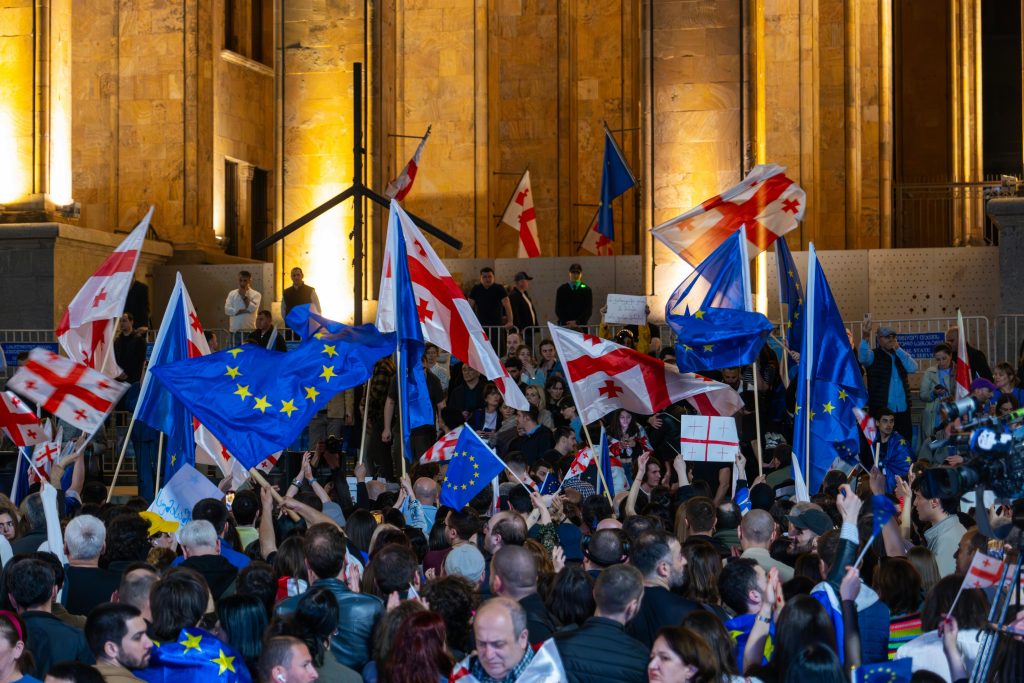
Protestors in Tbilisi, Georgia, 2024 © Photo: Pexels – Ramaz Bluashvili
Facing the Georgian Dream party’s halt to EU accession, Georgian youth activists have taken on an unofficial diplomatic role. At the November 2025 JEF Europe Congress, the integration of JEF Georgia served as a deliberate, symbolic lifeline from European peers, replacing the state’s mission. This civil diplomacy keeps the country’s pro-European will visible.
“I am Georgian. Therefore, I am European.” — Zurab Zhvania, former Georgian Prime Minister, speaking to the Council of Europe in 1999. This powerful declaration, made over two decades ago, once defined Georgia’s unwavering trajectory toward the EU. It was an affirmation of identity, not merely policy. For generations of Georgians, especially the youth, integration into the European Union has been seen as the natural, historical destiny of their nation. This sentiment culminated in December 2023, when Tbilisi achieved official status as an EU candidate country.
Yet today, the two-decade-long work from the 2003 Rose revolution is under threat, not from an external power, but from the ruling government itself.
In a surprisingly brutal and quick reversal, the Georgian Dream party has escalated its anti-democratic agenda, as evidenced by the controversial “Foreign Agents Law” officially titled the Law on Transparency of Foreign Influence and the declared intention to suspend progress on EU accession. This political pivot has led to an official, state-level degradation of diplomatic ties between Tbilisi, European countries and the EU itself. In the 2025 enlargement report, the Commission, through the European Commissioner for enlargement Marta Kos has responded by declaring Georgia a “candidate in name only,” effectively suspending the accession process.
This is where a profound shift occurs. With the government abandoning its core commitment, the vital relationship between Georgia and the EU is being maintained by those most directly targeted by the crackdown: civil society and, most visibly, its youth associations.
This article shows that youth associations have stepped into the diplomatic sphere, replacing the ruling government in maintaining the link with Europe. They have become the essential, unofficial diplomatic channel, working within Georgia to protest the anti-democratic trend and internationally to ensure the European community does not forget the pro-European will of the vast majority of Georgians despite the legal obstacles from the government. The youth are now one of the political representatives of Georgia’s European identity.
Youth as the national spearhead: the domestic fight
In response to this authoritarian pivot, Georgian youth and student associations have emerged as the most visible and resilient spearhead of the national opposition movement. For them, the fight is not just political, but existential: the European future represents democratic values, opportunity, and escape from the historical shadow of Russian influence.
Youth are paramount in this domestic struggle for several reasons: they are digitally native, highly organized across social platforms, and their deep-seated desire for change makes them unafraid of state intimidation. They are the driving force behind the continuous protest efforts within the country.
Since the government’s November 2024 decision to halt EU negotiations, street protests in Tbilisi and other cities have been relentless. Youth groups have organized massive, creative demonstrations using peaceful resistance and symbolic actions to sustain momentum against an intensifying police crackdown. By maintaining a constant, vocal presence in the streets, youth associations preserve the visibility of Georgia’s European identity inside its borders. They are living proof that the government’s anti-EU rhetoric does not reflect the overwhelming will of the Georgian people.
Exporting the fight: the new civil diplomacy
The most critical function of these youth groups has been their role in maintaining the international bridge to Europe. Unable to rely on the Georgian state for credible diplomatic outreach, civil society leaders and young activists have been forced to maintain the link with Europe, ensuring that the European Union does not completely disconnect from the Georgian people, even as relations with the government deteriorate.
This effort to export the struggle was perfectly illustrated by the recent JEF Europe Congress held from November 13 to 16. JEF (Young European Federalists) is a leading youth political NGO advocating for a democratic European federation. At this congress, JEF Europe officially integrated new member sections from Ukraine, Moldova, and Georgia.
For Ukraine and Moldova, this integration is a natural extension of their governments’ clear, pro-European agendas. For Georgia, however, the meaning is radically different. The inclusion of JEF Georgia is a deliberate act of diplomacy driven by civil-society, a direct, symbolic lifeline thrown by Georgian youth to their European peers.
While the Georgian government moves to dismantle democratic institutions and suspend accession talks, the youth, through organizations like JEF Georgia, are successfully inserting themselves into the European political network. They intend to replace the state’s mission by validating the Georgian people’s desire for integration through non-state channels, thereby avoiding a total rupture with the EU.
The future of a youth-driven European Georgia
The story of Georgia’s EU aspirations is no longer one of state policy, but of popular resilience. The “diplomatisation” carried out by young people is a powerful counter-narrative to democratic backsliding, demonstrating that the pro-European identity of a nation can survive when its government chooses isolation. Georgian youth associations have taken on an immense burden: maintaining diplomatic ties, acting as a bridge between the country and Europe, and preserving the hope of integration.
The core question remains whether this young, energized civil society can ever overcome the brute force of a tightening regime. But one thing is certain: the fight for a European Georgia has found its fierce new champions in a generation that simply refuses to let a backward-looking political elite dictate their future.